The main objectives were:
- To strengthen the UK and Southern African human infrastructure development in Mathematical Sciences research through capacity building,
- To forge and sustain collaborative relationships between applied mathematicians in the UK and Sub-Saharan Africa (SSA) on both research and teaching fronts aimed at untangling development challenges faced by Official Development Assistance (ODA) countries in the SSA region, and
- To use mathematics to influence government policies on disease, crime and wildlife management, control and prevention. The mode for building capacity within UK-APASI is to address existing and emerging questions relevant for SSA (e.g. control of infection disease transmission, control of crime spread, management and conservation of wild-life) using applied mathematics both interdisciplinary and inter-institutionally.
In partnership with the Southern Africa Mathematical Sciences Association (SAMSA) which is a regional umbrella representing over 40 Universities throughout the Sub-Saharan Africa region (see http://samsa-math.org/home-2/about-samsa/ for details), the UK-APASI programme will train a new generation of future leaders for Africa, highly skilled in the applications of mathematics to real-life problems in SSA. SAMSA will help us to recruit and train African researchers including Masters, PhD, Postdocs and Early Career Faculty as well as mentoring Heads of Departments of Mathematics on research and teaching management and good practice. A cohort of PhD students will be recruited from outside Africa to participate in the research activities and part of their role is to provide student-to-student mentoring of African researchers.
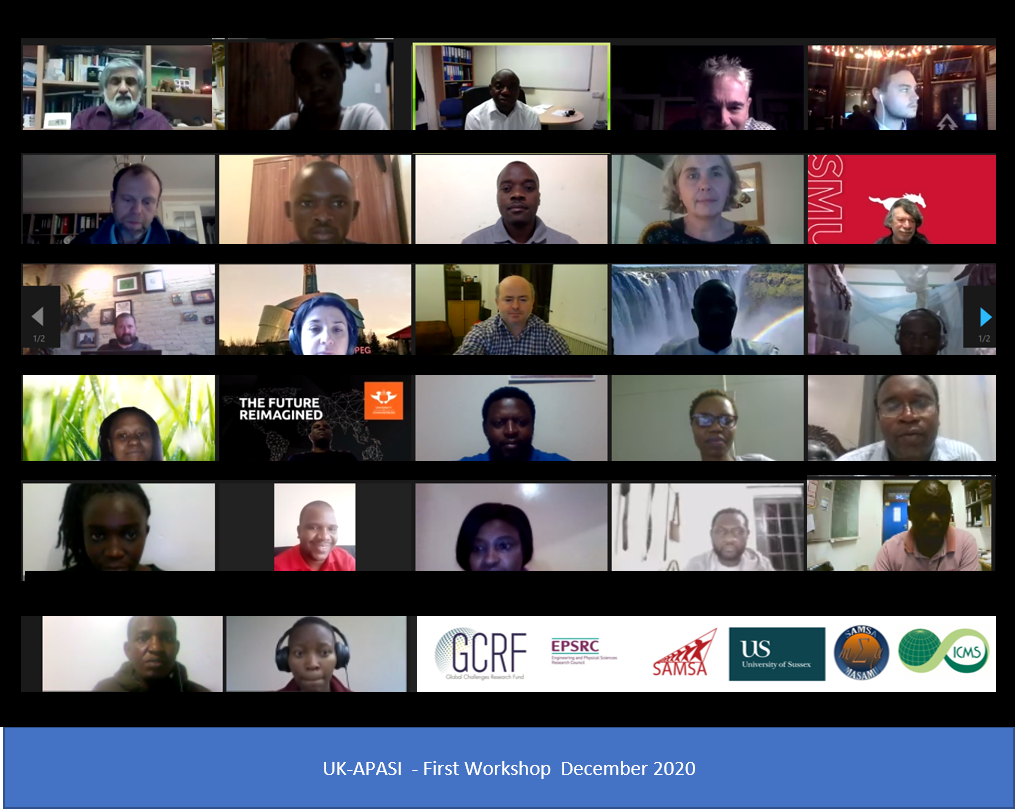
Due to COVID-19, all activities were delivered online with the support of ICMS, Edinburgh, Scotland.
As outcomes, virtual research groups will be formed in the areas of mathematics applied to health, crime and ecology questions in SSA, with emphasis on publishable research outcomes on problems of global significant to SSA. The research groups will interact virtually through zoom, Skype or other Telecon facilities throughout the life-time of the project and are expected to establish long-term collaborations beyond the lifetime of the training network.
The UK-APASI Program is supported by the United Kingdom Global Challenges Research Fund and the Engineering and Physical Sciences Research Council under Grant Ref: EP/T00410X/1

 Programme